

House Affligem / Atelier Tom Vanhee
A former textile factory is transformed into tiny house. we keep the traces of the several renovations in the past and we ad a new layer to the building.
A former textile factory is transformed into tiny house. we keep the traces of the several renovations in the past and we ad a new layer to the building.
the entire retail space is wrapped in metallic silver, creating an upscale industrial art atmosphere.
The post colored acrylic and metallic finishes adorn yebin design’s retail space in shenzhen appeared first on designboom | architecture & d…
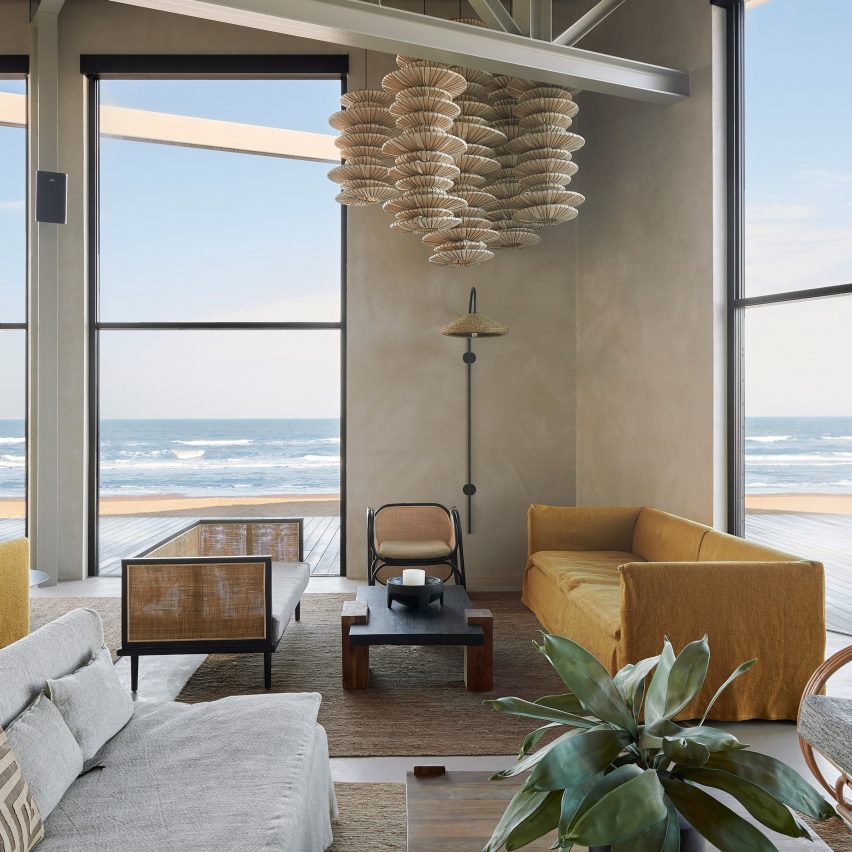
Sand-coloured walls serve as a backdrop to the linen, cane and teak wood furnishings inside this beachside restaurant and bar near Amsterdam, designed by Anne Claus Interiors. De Republiek is set along a stretch of beach in Bloemendaal aan Zee, a seaside neighbourhood just an hour’s train ride from central Amsterdam. For the past 17
The post Anne Claus Interiors uses natural materials and earth-tone colours for beach restaurant De Republiek appeared first on Dezeen.
a low, horizontal window at the level of the floor generates a visual connection with a shadowed yard of loose stones.
The post santiago viale plays with shadows and exposed concrete in villa allende, argentina appeared first on designboom | architectu…
a low, horizontal window at the level of the floor generates a visual connection with a shadowed yard of loose stones.
The post santiago viale plays with shadows and exposed concrete in villa allende, argentina appeared first on designboom | architectu…
Architect Wang Shuo was born in 1981 in Beijing. He grew up in the family of neuroscientists and was particularly good in math, wining the national math Olympics in high school. But instead of going into computer science, as did many of his classmates, he decided to study architecture. The decision was entirely intuitive. He earned his Bachelor of Architecture from Tsinghua University in Beijing in 2004. The Master’s degree was acquired from Rice University in Houston in 2006. His thesis was called Wild Beijing, in which he focused on the emergence of spontaneous urbanism in Beijing. After completing his training, Wang worked for one year at Peter Gluck’s firm GLUCK+ in New York. The office is known for specializing in hands-on design-built projects and acting as general contractor, which gives the architects a lot of control over quality of construction. Following Wang’s time in America, he relocated to Europe for two years, working at OMA in Rotterdam where he interacted with Rem Koolhaas, working particularly on projectsб in which various layers of social, cultural, and everyday life were overlapped to create active, truly contemporary spaces.
Construction with earthen materials, as one of the oldest traditional technology, was widely employed all over China during the past thousands of years. According to the latest statistics, at least 60 million people in China are still living in various traditional rammed-earth dwellings, most of which are located in poor and rural regions. In recent decades, due to the fact that the earth-based technology is usually regarded as a “dangerous” tech and a symbol of “poverty” by dwellers and governments, an increasing number of rammed-earth dwellings have been abandoned and replaced by conventional constructions with concrete and fired-bricks. However, limited by the low level of economy, technology and education conditions, most of renewed concrete-brick-based dwellings have even worse performances in comfortability, anti-seismic capacity and sustainability.
Michael McKinnell, a British-born American architect, known for his work on the acclaimed Boston’s Brutalist City Hall, and co-founder of the Kallmann McKinnell & Wood architectural design firm, has passed away on March 27, 2020, at the age of 84, from COVID-19-induced pneumonia.
The El Porvenir Child Development Center is a public institution, located in the municipality of Rionegro, Antioquia. The centre can house up to a total of four hundred children, mainly inhabitants of the neighbouring neighbourhood of the same name.
Copyright © 2026 | WordPress Theme by MH Themes