

Courtesy of Oyler Wu Collaborative
- Architects: Oyler Wu Collaborative
- Location: Columbus, IN, United States
- Design Team: Oyler Wu Collaborative: Dwayne Oyler, Jenny Wu, Hans Koesters, Lung Chi Chang, Harrison Steinbuch, Irvin Shaifa, Clint Johnson, Andy Magner, Dongwoo Suk, Andrea Sanchez, Hsiyuan Pan, Thomas Lanham, Emilijia Landsbergis, Suhan Na, Ibrahim Ibrahim, Tucker van Leuwen-Hall
- Engineering: Nous Engineering, Matthew Melnyk, Katahdin Engineering LLC, Elizabeth Woolf
- Project Year: 2017

Courtesy of Oyler Wu Collaborative

Plan
From the architect. The Exchange sits within the plaza adjacent to the Irwin Conference Center by Eero Saarinen (formerly the Irwin Union Bank) and makes use of the three existing canopies that formerly served the drive-through bank tellers. The design challenge was to “activate” the space while relating a contemporary design concept to the historic building and existing site conditions.

Courtesy of Oyler Wu Collaborative
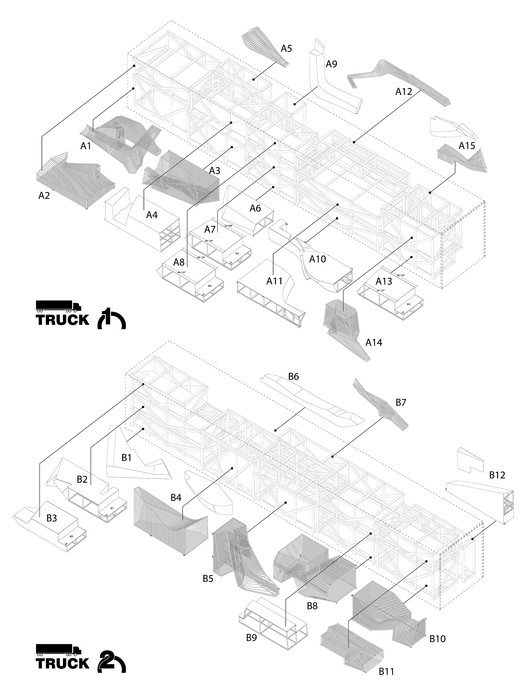
Isometric
Oyler Wu’s research into Eero Saarinen’s oeuvre, along with analysis of the site, led to a focus on three keys concepts: the unification of the existing canopies into a rectangular volume, solid/void relationships that include a “loose fit” placement of solid elements within carved voids throughout the scheme, and the use of contrasting tectonic strategies of solid and frame. The intention of this strategy is to produce the sense that the pavilion is simultaneously brand new and that it has always been there.

Courtesy of Oyler Wu Collaborative
The pavilion defines a new public space on the site by completing the geometries implied by the three canopies, legacies of Irwin Conference Center’s history as a drive-up bank. The pavilion provides a range of porosities, from semi-private spaces to open areas defined only by the nuanced spatial containment of the implied volume. The pavilion is composed of a complex mixture of volumetric walls and systems of intricate framework that wind its way through the volume. It is further enlivened by a sophisticated tectonic interplay of embedded objects derived from Oyler Wu’s particular interest in line/volume relationships. The resulting complex of overhead elements, walls, and benches produce new areas of containment and new points of destination.

Courtesy of Oyler Wu Collaborative

Courtesy of Oyler Wu Collaborative